A member's card gets declined, the charge doesn't go through, and nobody tells them. Three weeks later they notice they haven't been billed, assume they canceled on their own, and never think to call back. For a membership or subscription business, this is one of the quieter ways revenue slips away: not a decision to leave, just a billing hiccup nobody caught in time.
Failed payment recovery is the process of catching a declined charge, retrying it where your payment provider supports that, and reaching the member with clear, low-pressure communication until the payment goes through or the member makes an informed choice to pause or cancel. Done well, it gives many failed payments a chance to clear within a few days, often without the member feeling chased.
Not every failed payment is the same kind of problem, though. A charge can fail because a bank declined it, because the processor tried again and the card still didn't work, or because the member actively disputed the charge with their bank instead of contacting you. Treating all three the same way, as if each one means the member wants out, gets many of them wrong. The goal of a good recovery process is to fix what's fixable and respect the member who genuinely wants to stop.
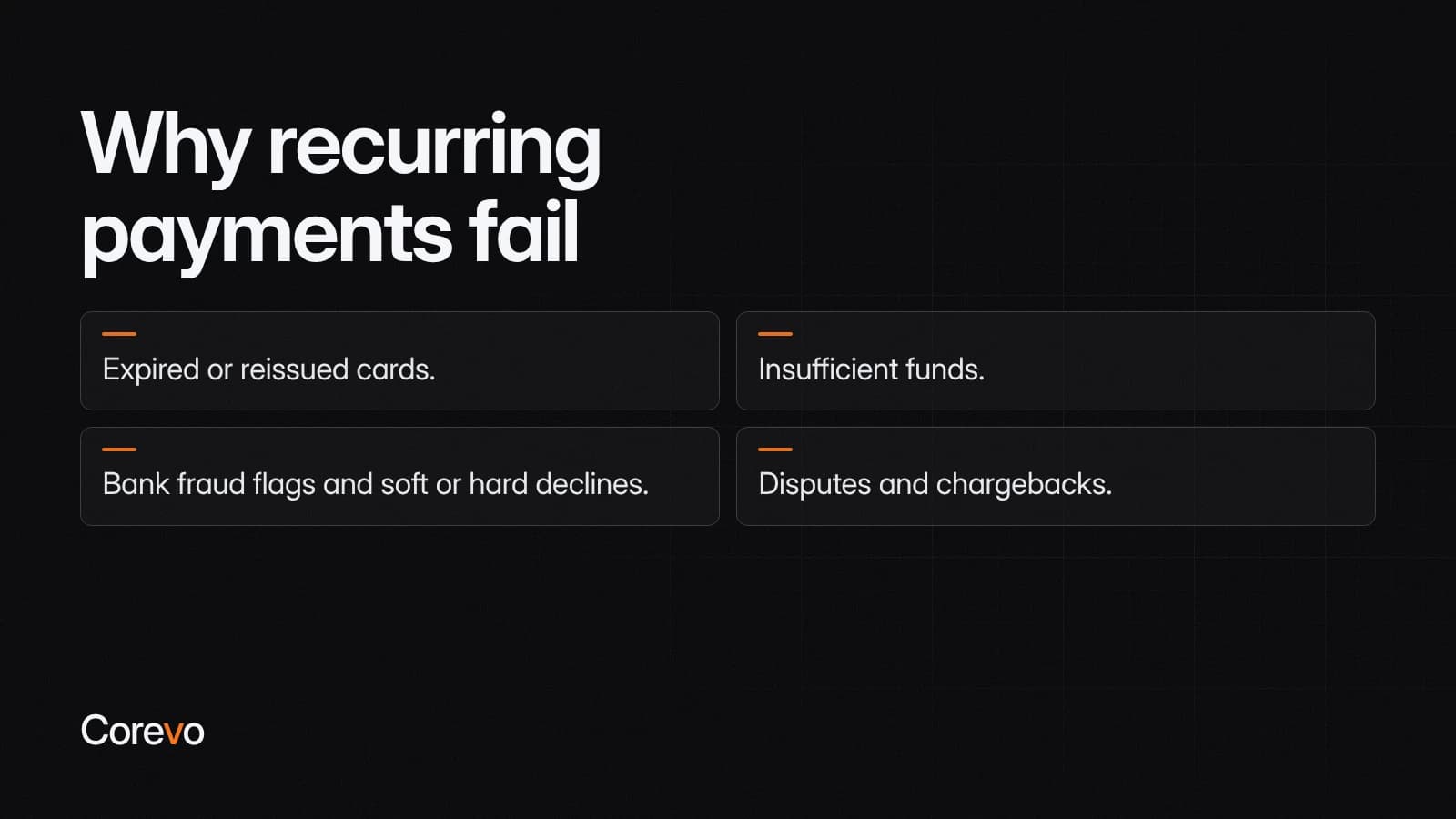
Why recurring payments fail
Most failed charges fall into a handful of categories, and most of them have nothing to do with whether the member is happy with their membership.
Expired or reissued cards. Cards expire on a schedule, and banks reissue them after fraud alerts, lost cards, or routine upgrades. The new card has a different number or expiration date, and the old one on file simply stops working. This is one of the most common reasons recurring billing fails, and it has nothing to do with the member's intent to pay.
Insufficient funds. A checking account runs low right before payday, or a debit card hits its daily limit. These declines often clear up within a few days on their own, which is exactly why a retry schedule matters more than an immediate cancellation.
Bank fraud flags and soft or hard declines. Banks sometimes block a charge because it looks unusual: a new merchant name, a charge amount that changed, or simple pattern-matching that has nothing to do with the member's account health. This is sometimes called a soft decline, meaning the bank might approve the same charge on a later attempt, compared to a hard decline, where the card itself is closed or invalid and won't work again without new card information.
Disputes and chargebacks. A dispute is different from a decline. Here, the member contacted their bank directly and contested a charge instead of reaching out to you or canceling through your system. The money was collected and then clawed back, and it often signals real dissatisfaction or confusion about the charge rather than a lapsed card. A dispute isn't fixed by retrying the charge: it needs a conversation with the member about what went wrong, and if disputes happen often, a check with your payment processor about how they affect your account.
Knowing which category you're dealing with changes the right response. A soft decline deserves a retry. A hard decline deserves a direct request for updated card details. A dispute deserves a conversation, not an automated nudge to update a card that was never the problem.
The recovery sequence
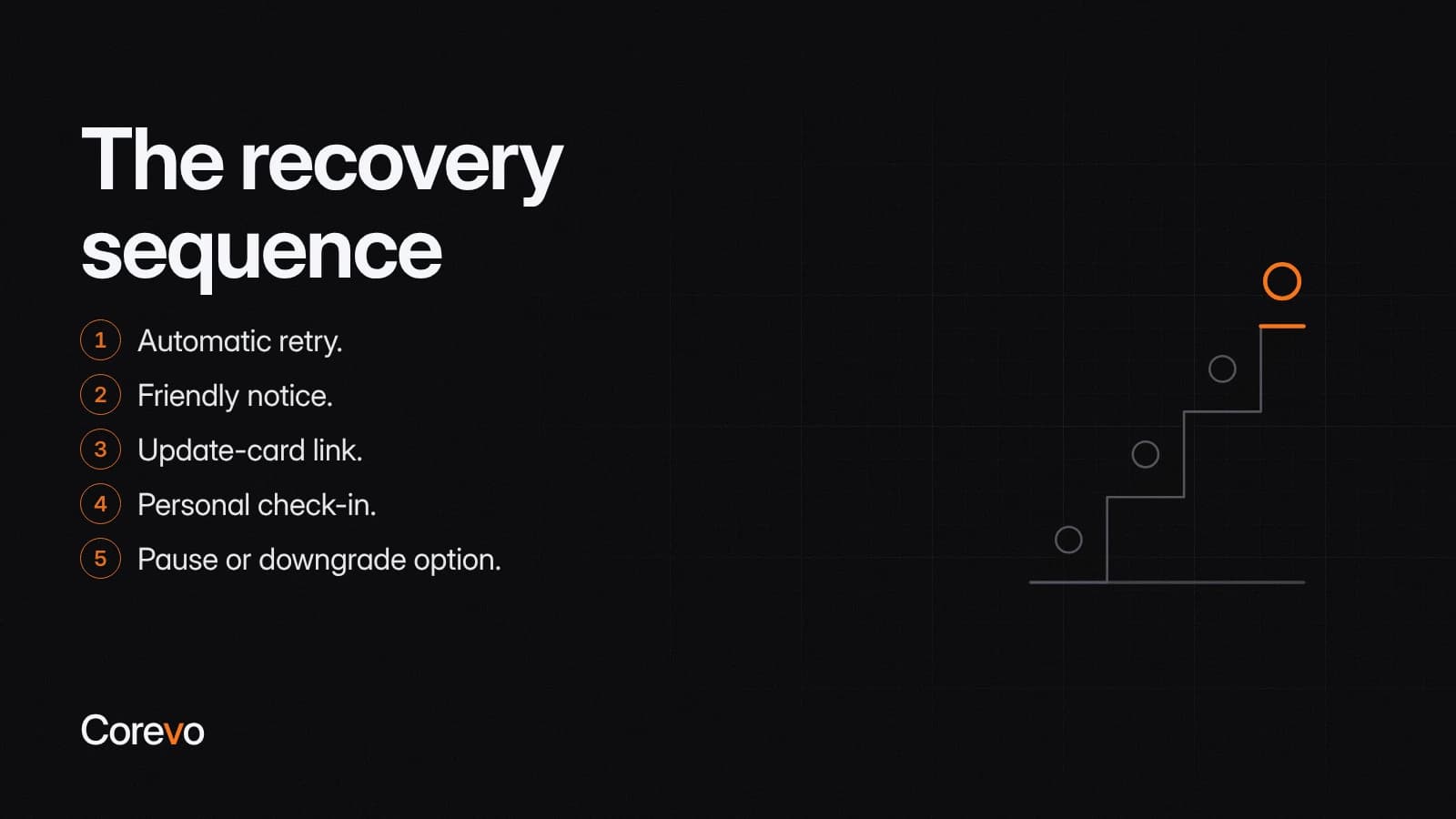
A good recovery sequence gives the payment every reasonable chance to succeed before it asks the member to do anything, and only escalates to a personal touch if the automated steps don't work.
-
Automatic retry. Many payment processors and checkout platforms can attempt the charge again after a short delay, often a day or two, since many declines resolve themselves once a balance clears or a bank lifts a temporary hold. How many retries happen, how long the gaps are, and whether retries are automatic at all varies by processor and by how your checkout is configured, so it's worth confirming what your specific setup does rather than assuming. Where it's active, this step alone can recover a meaningful share of failed payments with zero effort from the member.
-
Friendly notice. If the retry fails, send a short, plain message letting the member know the payment didn't go through and that it's a simple fix. No alarm, no late fees mentioned, no guilt. Just a heads-up and a next step.
-
Update-card link. Give the member a direct, simple way to update their card information. The easier this step is, the faster payments tend to recover. A member who has to call in or dig through a website to fix a declined card is a member who puts it off.
-
Personal check-in. If a few days pass with no response, a short call or personalized text from a real person on your team often works better than another automated message. This is especially worth doing for higher-value memberships or long-standing members, where a brief human conversation can clear up confusion that automation can't.
-
Pause or downgrade option. If the member still hasn't updated their payment after a reasonable window, offer a graceful option: pause the membership for a short period, or move to a lower-cost plan, rather than an abrupt cancellation. This keeps the door open and respects that life circumstances sometimes mean someone genuinely can't continue right now.
Whatever sequence you run, stop it the moment the payment clears or the member tells you directly they want to cancel. Continuing to send "please update your card" reminders after someone has told you they're done just turns a clean exit into an irritating one.
Example messages
The tone matters as much as the timing. These examples stay short, specific, and free of pressure.
First notice (day 1 or 2 after the decline): "Hi [first name], we tried to process your monthly payment and it didn't go through. This usually just means a card expired or a bank held the charge. No rush, just update your card here when you get a chance: [update link]."
Reminder (day 4 or 5, if no response): "Hi [first name], following up on your payment, it still hasn't gone through. Your membership is still active for now, but we want to make sure you don't lose access. Update your card here: [update link]. Reply if you'd like help."
Personal check-in (day 7 or later, if no response): "Hi [first name], this is [team member] from [business]. I noticed your last payment didn't process and wanted to check in directly, no worries either way. If now isn't a good time for your membership, we can pause it or adjust your plan. Just let me know what works."
Each message gets a little more personal as time passes, and each one assumes good intent on the member's part, right up until the member says otherwise. If someone replies that they want to cancel, that's the answer: stop the sequence and process it instead of sending another payment reminder.
Preventing churn from card failures
The best recovery sequence is the one you rarely need, because most card failures are predictable and some can be headed off before they happen.
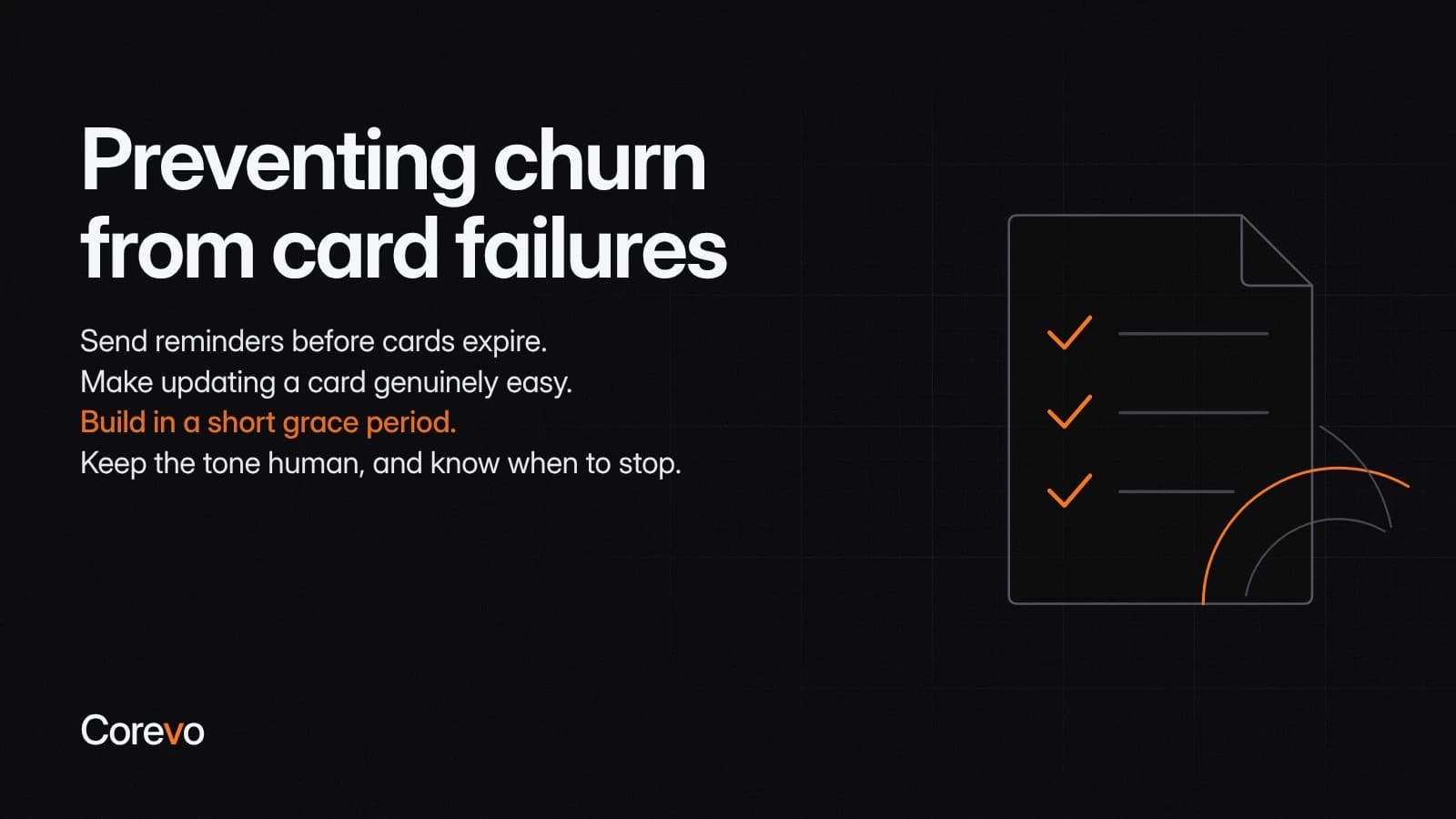
Send reminders before cards expire. If your billing system shows an expiration date on file, a quick heads-up a few weeks ahead of that date, "your card on file expires soon, update it here," prevents the decline entirely.
Make updating a card genuinely easy. A member who hits a confusing form, has to create a new login, or can't find the link on their phone will put it off indefinitely. One click to a simple update page removes most of that friction.
Build in a short grace period. Cutting off access the moment a payment fails turns a billing hiccup into a confrontation. A few days of continued access while the sequence runs gives the member time to fix it without feeling punished for a bank's timing.
Keep the tone human, and know when to stop. Nothing accelerates churn like a message that sounds like a collections notice. And once a payment clears, or a member says plainly that they want to cancel, stop messaging them about it. Members who feel reminded, not chased, are more likely to update their card instead of quietly canceling, and members who've already told you their decision deserve to have it respected.
For businesses building out a membership or course program, this part of the billing experience deserves the same planning as pricing, onboarding, and retention practices, not something bolted on after members start leaving.
Handled this way, a failed payment becomes a minor, forgettable moment instead of a reason someone drifts away. Most members want to keep paying. Your job is to make that easy, and to let go cleanly when a member genuinely doesn't.